Terraform is an open-source Infrastructure as Code (IaC) tool created by HashiCorp that lets you define, provision, and manage cloud infrastructure across AWS, Azure, Google Cloud, and other providers using simple declarative configuration files written in HCL.
Still, By the end of this post, you’ll understand what systems as Code means. Additionally, you’ll learn how Terraform works under the hood and how to write your first setup file.

What Is Terraform? A Simple Explanation for Beginners
Terraform is an open-source tool that lets you define your cloud systems using code. Specifically, instead of clicking buttons in the AWS or Azure console, you write a simple text file — and Terraform builds everything for you. It’s built by HashiCorp and it works across AWS, Azure, GCP, and dozens of other providers. In other words, one tool handles your entire cloud setup.
Think of it this way — if your cloud is a building, Terraform is the blueprint. You describe what the building should look like, and Terraform constructs it exactly as written. Thus, Because it uses code, you can also version it in Git, share it with your team, and rebuild it in minutes if something breaks.
This approach is called systems as Code (IaC) — a method where you treat your systems the same way you treat your application code. It’s one of the most important skills in DevOps in 2026.
Key Concept: systems as Code (IaC) means you manage servers, networks, and databases using config files instead of manual steps. Terraform is the most popular IaC tool in the industry today.
Why Terraform for Beginners Is the Best DevOps Starting Point?
Generally, Terraform for beginners is the ideal entry point into DevOps automation for several reasons. First, it uses a simple, human-readable language called HCL (HashiCorp setup Language). You don’t need to be a programmer to understand it. If you can read plain English, you can read a Terraform file.
Additionally, Terraform works with every major cloud provider. So whether you’re learning AWS, Azure, or GCP, you use the same tool and the same workflow. That saves a lot of time. Since most DevOps job listings in 2026 mention Terraform as a key requirement, learning it early puts you ahead of the competition.
Here’s why it also makes systems safer: every change goes through a plan phase first. Terraform shows you exactly what it will create, modify, or destroy — before it does anything. You review the plan, then approve it. Plus, This prevents costly mistakes.
Core Terraform Concepts Every Beginner Must Know
1. Providers
A provider is a plugin that connects Terraform to a cloud platform. For example, the AWS provider lets Terraform talk to Amazon Web Services. The Azure provider lets it talk to Microsoft Azure. You declare a provider at the top of your config file, and Terraform downloads it on its own when you run terraform init.
2. Resources
Then, A resource is the actual systems you want to create. For example, an EC2 instance on AWS, a storage bucket on GCP, or a virtual machine on Azure. Each resource block tells Terraform what to build and how to configure it. Resources are the building blocks of every Terraform project.
3. The State File
Terraform keeps a file called terraform.tfstate that tracks everything it has built. This is the state file. It’s the source of truth for your systems. When you run Terraform again, it compares your new config to the state file and figures out what changed. As a result, it only updates what’s different — it doesn’t rebuild everything from scratch.
Exam Alert: The state file contains sensitive data. Never commit terraform.tfstate to a public Git repo. Use remote state (S3, Azure Blob, or Terraform Cloud) in real projects to store it securely.
4. Plan and Apply
Basically, These are the two most important Terraform commands. terraform plan shows you a preview of changes. terraform apply executes them. Always run plan before apply. Of course, This two-step process is what makes Terraform safe to use in production environments.
5. Modules
A module is a reusable block of Terraform code. Instead of writing the same resource blocks over and over, you wrap them in a module and call it whenever you need it. Also, Think of modules like functions in programming — write once, use many times. In practice, most teams share modules across projects to keep their code clean and consistent.
The 5 Terraform Commands Every Beginner Uses Daily
You don’t need to memorize every Terraform command. However, these five will cover 90% of your daily work.
terraform init
Initializes your project. So, Downloads providers and sets up the backend. Run this first in every new Terraform folder.
terraform plan
Shows a preview of what Terraform will create, change, or destroy. Always run this before applying changes.
terraform apply
Yet, executes the plan and builds your systems. It asks for confirmation before making any changes.
terraform destroy
Deletes all systems managed by your config. Use with caution — it tears down everything in the state file.
terraform validate
Clearly, checks your config files for syntax errors without connecting to any cloud. Useful before running a plan.
Your First Terraform File: A Step-by-Step Example
Let’s look at a simple Terraform config that creates an S3 bucket on AWS. Even if you’re just starting out, you’ll be able to read this clearly.
main.tf — Your First Terraform Config
In fact, terraform {
  required_providers {
    aws = {
      source  = "hashicorp/aws"
      version = "~> 5.0"
    }
  }
}

provider "aws" {
  region = "us-east-1"
}

resource "aws_s3_bucket" "my_bucket" {
  bucket = "my-first-terraform-bucket-2026"
}
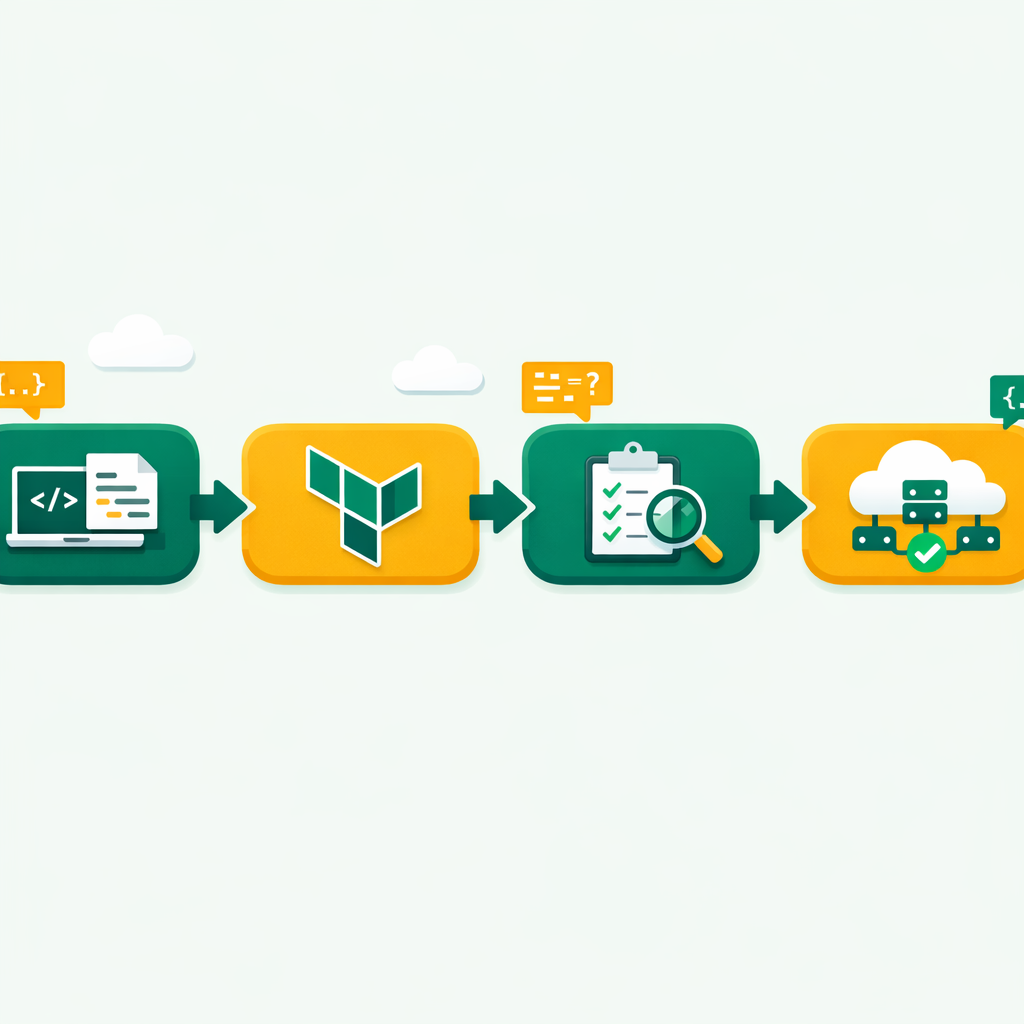
Here’s what each block does. The terraform block tells Terraform which providers to download. The provider block sets your AWS region. The resource block creates the actual S3 bucket. Once you save this file, run terraform init, then terraform plan, then terraform apply — and your bucket appears in AWS.
It’s that simple. In fact, after running these three commands, your systems is live. No clicking, no console — just code. As a result, you save time and reduce errors.
Pro Tip: Name your resource files logically — main.tf for core resources, variables.tf for inputs, outputs.tf for outputs. This structure keeps larger projects clean and easy to navigate.
Common Terraform Mistakes Beginners Make (And How to Avoid Them)
Naturally, learning Terraform for beginners means running into a few predictable problems. Although these mistakes are common, they’re also easy to fix once you know what to watch for.
Committing the State File to Git
The state file contains secrets and resource IDs. Therefore, use a remote backend like S3 or Terraform Cloud to store it safely.
Skipping terraform plan
Still, Jumping straight to apply is risky. Always review the plan output first. It shows you exactly what will change — so there are no surprises.
Hardcoding Credentials
Never put your AWS access keys or passwords directly in a Terraform file. Next, use environment variables or a secrets manager instead.
Not Using Variables
Hardcoding values like region or instance type makes your code rigid. Use variables so your config works across multiple environments without rewriting it.
Terraform vs Other DevOps Tools: What’s the Difference?
Thus, beginners often confuse Terraform with other DevOps tools. Here’s a quick breakdown so you don’t mix them up.
Terraform is a provisioning tool — it creates and manages cloud systems. Ansible, on the other hand, is a setup management tool — it installs software and configures servers after they exist. Similarly, Docker packages your app into containers, while Terraform can deploy the servers those containers run on. These tools work together, not against each other. Generally, Most modern DevOps pipelines use all three in combination.
In contrast to AWS CloudFormation, Terraform is cloud-agnostic. CloudFormation only works with AWS. Terraform works with AWS, Azure, GCP, and over 1,000 other providers. So if your team uses a multi-cloud setup, Terraform is clearly the better choice.
How Terraform Skills Boost Your DevOps Career in 2026
Terraform for beginners isn’t just a learning exercise — it’s a direct path to better job opportunities. Naturally, In 2026, IaC skills are listed in a large share of DevOps, cloud engineer, and SRE job descriptions. Employers want engineers who can automate systems, not just manage it manually.
Once you’re comfortable with Terraform basics, you can pursue the HashiCorp Terraform Associate certification. It’s an entry-level cert that validates your IaC skills and looks strong on a resume. Plus, After that, combining Terraform with AWS or Azure knowledge makes your profile stand out even more. Start with this guide, build a few projects, and you’ll have solid hands-on experience to show interviewers.
Frequently Asked Questions
What is Infrastructure as Code and why is it important?
Infrastructure as Code (IaC) is the practice of managing and provisioning servers, networks, and cloud resources through machine-readable configuration files instead of manual processes. It eliminates human error, makes infrastructure reproducible, and allows teams to version-control their entire environment just like application code.
What is the difference between Terraform and Ansible?
Terraform is a provisioning tool that creates and manages cloud infrastructure like VMs, networks, and databases. Ansible is a configuration management tool that installs software and configures settings on existing servers. Many teams use both together in their DevOps workflow.
What is a Terraform state file and why does it matter?
The Terraform state file tracks the current state of your infrastructure so Terraform knows what resources already exist and what changes need to be made. Losing or corrupting this file can cause Terraform to lose track of resources, so it should always be stored in a remote backend like S3 with state locking enabled.
What programming language does Terraform use?
Terraform uses HashiCorp Configuration Language (HCL), a declarative language designed specifically for defining infrastructure. HCL is beginner-friendly with a simple block-based syntax, and you do not need prior programming experience to learn it.
Which cloud providers does Terraform support?
Terraform supports all major cloud providers including AWS, Azure, and Google Cloud through official providers. It also supports hundreds of other services like Kubernetes, GitHub, Cloudflare, and Datadog, making it the most versatile IaC tool available.
Ready to Master DevOps Tools Like Terraform?
Bhanu’s DevOps training covers Terraform, CI/CD pipelines, Docker, and real-world cloud automation — designed specifically for IT students who want job-ready skills fast. Join the online program and build your DevOps career from the ground up.
Official Resources
- HashiCorp Terraform Official Docs
- Terraform Tutorials by HashiCorp
- Terraform Registry — Providers and Modules